

- First Steps
- Into the Thick of it
- Wagenpark-Verzeichnis
- Intermission
- Historical Context – 5069
- Wider Historical Context
- Conclusions
In the club’s research guide, I gave an overview on how to conduct research on European railroads. In this blog, we’re going to go through an example investigation; looking for Pfalzbahn passenger coaches to model!
For the uninitiated, the Pfalzbahn, more properly the Pfälzischen Eisenbahnen (Palatinate Railways) and later the Pfälzische Netz (Palatine Network) of the Königlich Bayerische Staatseisenbahnen (Royal Bavarian State Railways), are the railways that ran through the Kurpfalz (Electoral Palatinate) in Germany, modern Rheinland-Pfalz. It’s esoteric enough to make for a good example for research but large enough that it will be relatively easy to find a starting point.
First Steps
Let’s get a little more specific, and we can build outward if necessary. This is an actual, not pre-baked research question, so you’ll be following along as I write this in real-time with the research. We’re going to look for early stock, say, pre-1900. We’ll also look for non-bogie coaches, specifically two-axle. We can start by searching for information about the railway itself, in hopes we can find an equipment roster. The gameplan is to find a roster, then search for more details about specific coach types when we have their names, service dates, and other details.
A quick search for “Pfalzbahn” on my search engine of choice brings up… Wikipedia! In German and English. Thankfully for me, I can read German, so I’ll open both. We’re really going to skim here. English Wikipedia gives us basic overview and a page on the locomotives and railbuses for the railway; German Wikipedia is much more in-depth and has a section on rollingstock, as well as locomotives and Triebwagen, on the main Pfalzbahn article. The English page cites one source for its information on stock, Albert Mühl’s Die Pfalzbahn: Geschichte, Betrieb, und Fahrzeuge der Pfälzischen Eisenbahnen. (Thankfully for us, I am cheating slightly, as good friend and fellow ETEr Jan Schiefer has lent it to me on a long-term loan and I thus already had the book and some idea of what we’re getting into.) German Wikipedia has far more detail and provides us with two additional sources; Die Reisezugwagen der Deutschen Länderbahnen Vol. II by Emil Konrad and Jan Maier & Philipp Mandrys’ “In seiner vollen Aussagekraft” in EisenbahnGeschichte Issue 74 (February-March 2016), p. 4–9. On a link on that Wikipedia page takes us to a list of Pfalzbahn passenger coaches; here we find the same sources as before, but with a new treat! The Pfalzbahn wagon fleet roster by the Bavarians in 1913.
Into the Thick of it
I couldn’t make it too easy on us, and have neither of the sources listed from German Pfalzbahn Wikipedia. Let’s start with the magazine article. EisenbahnGeschichte is a magazine published by DGEG Deutsche Gesellschaft für Eisenbahngeschichte (German Association for Railway History). Searching for the magazine issue via search engine reveals a few sites to purchase the magazine, and DGEG-medien. DGEG-Medien unfortunately didn’t have the issue directly available for sale, but the main DGEG site had the contents of the article. The top theme? Restaurierung eines Pfalzbahnwagens (Restoration of a Pfalzbahn wagon)! So, from the article title and description, we learn that the DGEG Pfalzbahnmuseum in Neustadt/a.d.Weinstraße found the oldest extant Pfalzbahnwagen in a garden and restored it; it follows that the museum retains this wagon, which should prove a good visual representation. So here now we have one thread to follow become two; to track down the article, and track down the wagen.
Tracking down the museum coach proved to be difficult, in part because most photographers do not know the difference between coaches and because the museum’s website is fairly spartan in its photos of artifacts. That said, this appears to be the coach in question:

To find these photos, I combed through the search engine results as well as various DGEG websites. Additionally, as mentioned in the research guide, things may not be labeled how you expect! So, I looked on photo sharing sites with the photo location marked as the museum and combed through those as well.
In the search for the article, I looked to see if DGEG partnered with any libraries or services for free access but unfortunately couldn’t find anything on the subject. When trying to purchase the journal through DGEG, a slew of technical difficulties erupted, and prevented me from moving forward by myself. My next move? To email DGEG, of course!
While waiting for that reply to come in, it was time to chase my easy lead, the well-regarded monograph of Albert Mühl. In the “Fahrzeugskizzen” section of the book, we find an excellent example of a similar style of coach.
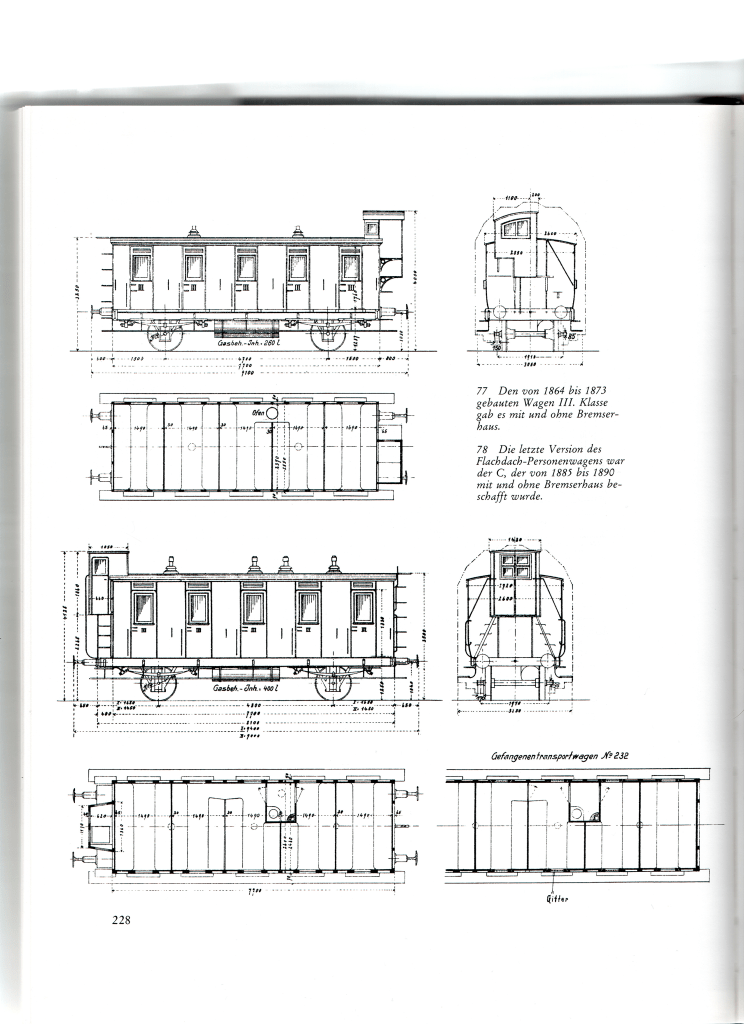
The listed remarks state that these styles of third-class coaches were made with and without brake-houses, which would seem to align with the coach depicted in the museum photographs. The vents and overall construction seem to suggest the coach here is contemporary 1864-1873 build pattern, but we’ll have to wait for DGEG to reply before we can know with certainty. For some extra background, we’ll refer to the “Wagen” section of the book.
But there’s more! Many of these coaches were later downgraded in class as newer, more luxurious coaches were introduced. Figure 77, originally a “C,” denoting third class, was demoted to a “D” sometime after 1913. Later scholars used a DRG-based identification system based on class and initial delivery year. As such, the coaches in figure 77 are sometimes listed as “D Pfalz 64.” Returning briefly to the Wagenpark-Verzeichnis mentioned earlier, Mühl has it listed as one of his sources and, in fact, pulls these designs from it. Because of the importance of the WV, some scholars will list WV Blatt # when discussing Pfälzische rollingstock. This meaning Wagenpark-Verzeichnis Leaf #. So this coach, appearing on leaf 33 (page 35) of the WV would be a WV Blatt 33. Keeping in mind that this was not a contemporary way to refer to the coaches.
Wagenpark-Verzeichnis
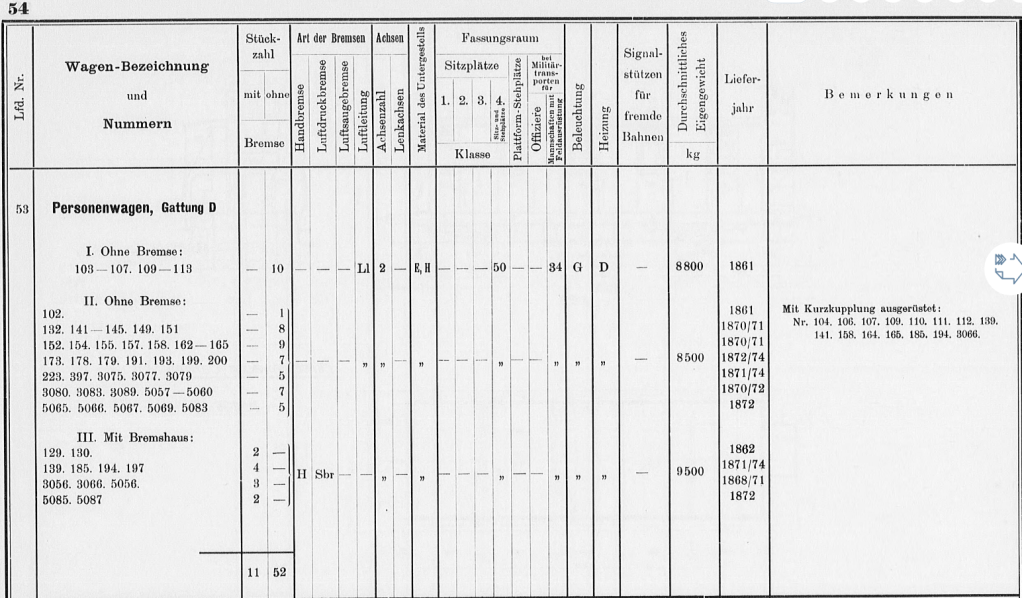
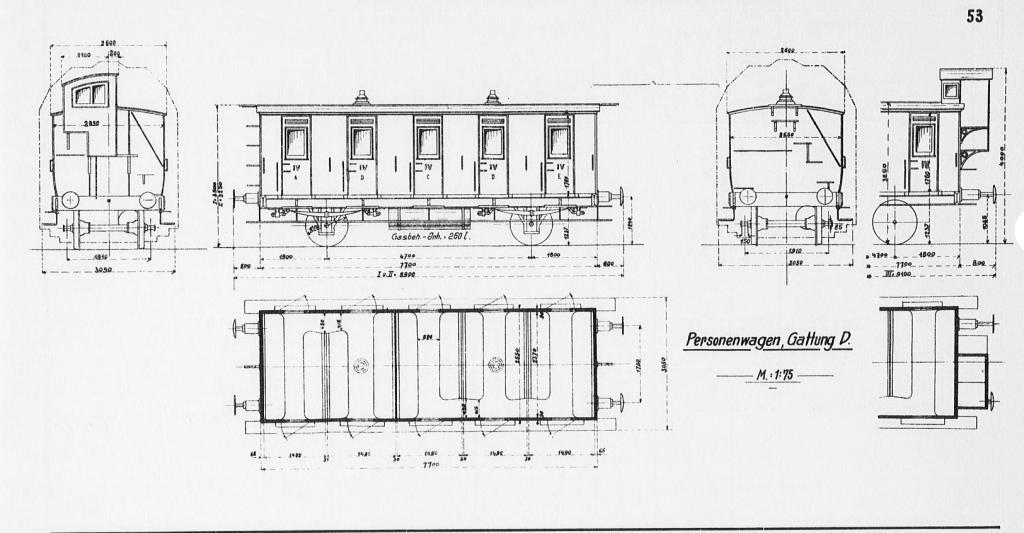
Given that you just read the heading title, you are aware that I have lied to you. This isn’t a brief return to the WV. Given that Mühl does not dedicate a beautiful full-page reproduction of every coach permutation, there is a lot for us to gain from the 1913 publication. Additionally, information about each piece of rollingstock is displayed next to the leaf with the sketch. The WV also provides us with an interesting detail that Mühl did not; scale. 1:75.
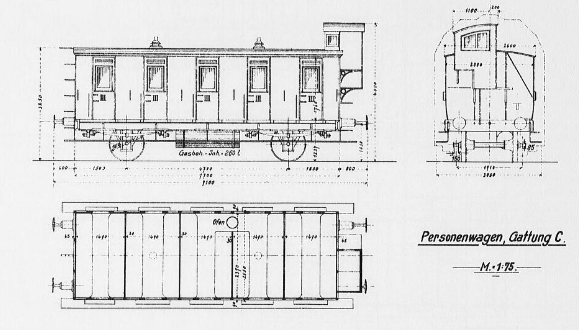
We also find a sign of the times. Each leaf has an interesting section of its chart; its suitability for military service. In this case, 38 troops with field kit. Indeed, one of the authors listed by DFG Viewer is, unsurprisingly, GeneralStab (General Staff). You may also wonder where the book comes from; Department IV of the Bavarian State Archive, War Archive, General Staff, 438.
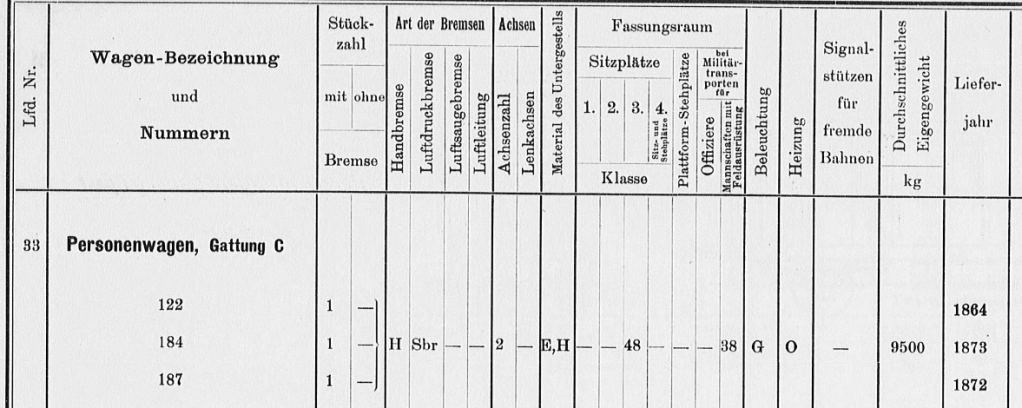
Also, the WV breaks down each pattern of coach by individual examples and their individual delivery date. We also learn that the coaches are made of metal and wood (Eisen, Holz; the E,H mentioned in the Material des Untergestells column). Further, the WV informs us of the renumbering of all rolling stock on the Pfälzische Netz (WV pp.III-X). They also give us an abbreviations guide on page XV, in case you got lost trying to figure out the difference between E,H and H E,E.
So, case closed, yes? We have the information we need from the WV! No need to go any further? Not quite. Let’s examine the nature of the WV and thus, its limitations:
- Produced in March of 1913, after the period of examination
- A complete inventory for military readiness purposes
- 317 pages in length
- No discussion of route usage, colors, history (aside from reconstruction dates where applicable), or consists
- Part detail lacking in places, note that the drawings do not mention the spoked wheels seen in the photo
So, while the WV is extraordinarily useful for both its standardization as a point of reference and for its detailed and precise rollingstock sketches, it is not the ultimate source for all things we would want to know about Pfalzbahn two-axle coaches.

Intermission
Well, this has already been a considerable effort for me to write and research, and probably for one to read. Even keeping track of all the sources we’ve discussed and the relevant details for each gets more and more complicated. What to do? Turn to our citation manager. As mentioned in the research guide, I prefer to use Zotero, as it’s free and has great functionality.
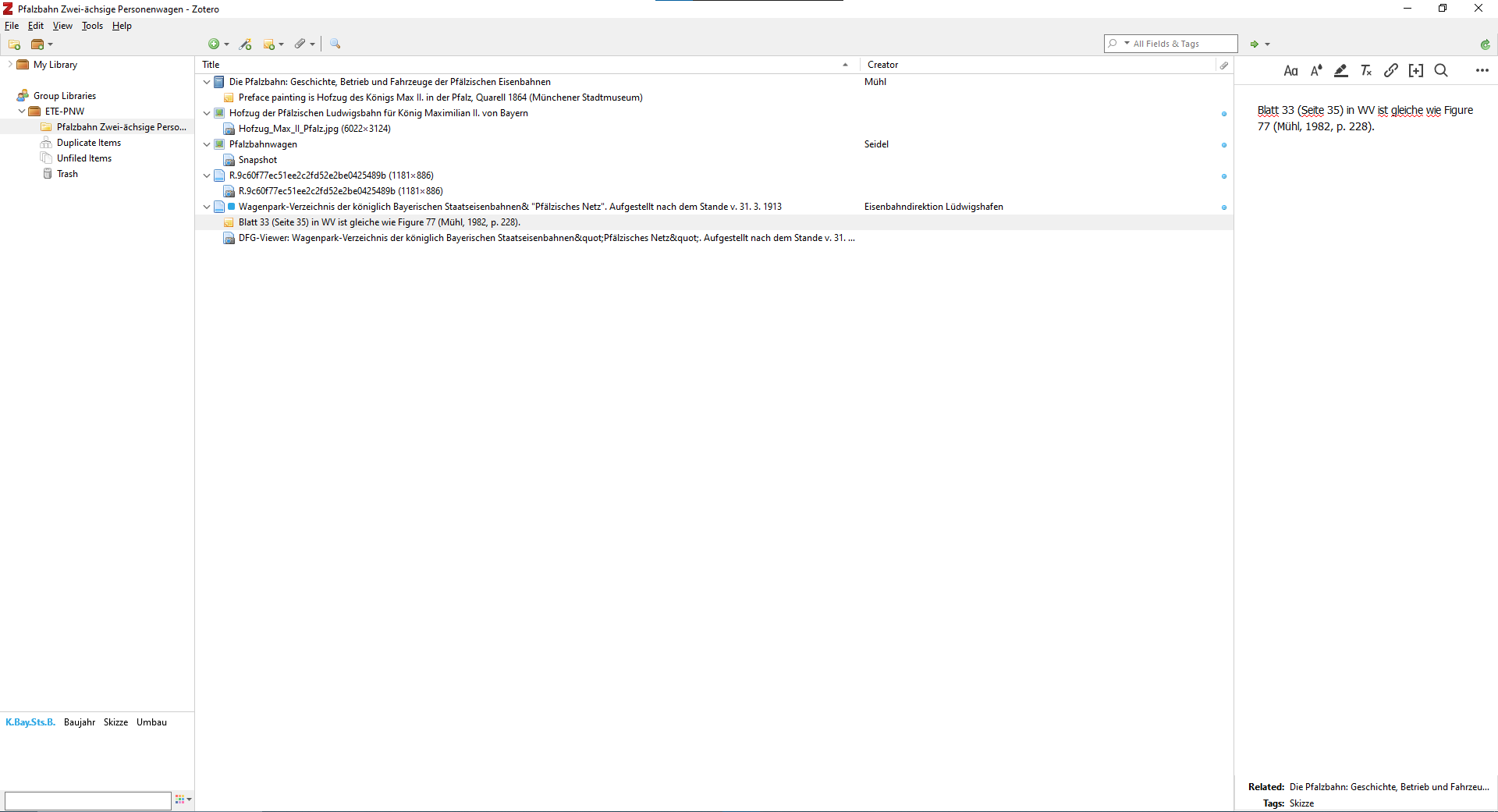
Here we can see that I’ve organized the sources we have gone over so far. In the bottom left are tags that I’ve assigned to sources, clicking on one will filter to only the sources with such a tag. On the right is a note that I’ve added underneath the WV in our working bibliography space. I make good use of the Zotero extension for my browser but be certain to include all the available information yourself, as Zotero can only populate those fields if the website supports that metadata. I can also include a specialty tag for related items, so that I know when one source is related to another. Even better, the notes can include citations as well, so I can reference an exact point in the text; very useful for full books like Die Pfalzbahn and WV. In fact, this very Zotero library is publicly available!
Historical Context – 5069
It is fortuitous timing that I received this morning an email back from DGEG with the article I requested! Inside, we find that the coach they found was a D (remembering from earlier this means a 4th-classs coach) Type, number 5069. We find indeed the corresponding WV Blatt 53 on page 54. From a batch of 5, we find 5069 with a delivery date of 1872. We find also that our earlier assumption was well-founded, as the two gas lamps and composite construction fall well in line with the 1864-1873 build pattern of C type coaches we examined earlier.
Maier and Mandrys explain that this coach was in service until 1921/22, making it a square 50 years in service. They remark that the restoration of the coach was a joint project between DGEG Pfalzbahn Museum Neustadt/Weinstraße, under Ralf Rudolph and Martin Petersmann and Generaldirektion Kulturelles Erbe Rheinland-Pfalz (General Direction Cultural Heritage Rhineland-Palatinate) under Claudia Gerne-Beuerle Dipl.-Rest. (FH) and Dr. Georg Peter Karn, which contracted Professors Dr. Frederika Waentig and Andreas Krupa Dipl.-Rest. (FH) M.A., along with their students, of the Institüt für Restauierungs- und Konsiervungswissenschaft (Institute for Resotration and Conservation Science) the Technischen Hochschule Köln.
Unfortunately, information on both the coach’s maker, Waggonfabrik Ludwigshafen, and the history of the Pfalzbahn wagons as a whole is hard to come by. Maier and Mandrys cite Emil Konrad’s Die Reisezugwagen der deutschen Länderbahnen Vol. II Bayern, Württemberg, Baden (Stuttgart, 1984) with the statement that Pfalz.B. inventory numbered 5001 to 5999 was in service on the cross-border line between Neustadt/Weinstraße and Weißenburg (now Wissembourg) in Elsass (Alsace). Returning briefly to Mühl, he informs both us and the researchers of 5069 that during the time of the Pfalzbahn as an independent venture until 1901, there were no fourth-class coaches. Like the Type C (WV Blatt 33) we looked at earlier, 5069 was introduced as a third-class coach.
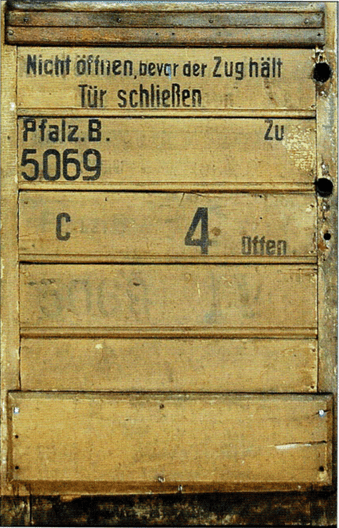
The combined team who worked on Pfalz.B.5069 determined through paint layer research that when first introduced, the coach was overall on the exterior a dark green, with black buffers and longitudinal members, while the roof was covered in a gray cloth. Colors of the grab irons, knobs, and steps could not be determined. Inside, the floor was dark red, the walls an ochre tone, and the roof was painted white. They also found that the railway remodeled the interior from July of 1912 to August of 1914 in order to meet new standards of passenger comfort; adding a toilet and steam heating, replacing the oil lamps with gas, and repainting the entire interior to a light ochre. Additionally, they found that these cross-border trains had writing on the doors in both French and German. Naturally, the addition of the toilet reduced the total number of passengers, down to forty-two from the original fifty. Personally, I dread to think about how they would fit even 42 passengers in such a small space, keeping in mind that if you discount the benches and dividing walls, the coach has a little less than 200 square feet of space.
Following the war, 5069 and many of the coaches that were 22 years of age or older were retained by the Pfalzbahn, as newer coaches without significant wear or damage were ceded to the French as part of the armistice. (This is also how SNCF ended up with several Pr. T18 locomotives, rebranded as SNCF 232TC.) Maier and Mandrys go on to say that the lack of brakes relegated such coaches to low-speed secondary and branchline services. To better accommodate their new lifestyle, the toilet added in the 1914 rebuild was removed. Additionally, the walls were redone in light ochre, the ceiling was now painted light gray and door stencils were now only in German. It is notable that the floor was not revised at this time. Note, while Mandrys and Maier state that the entire interior was painted light ochre in 1914, this paragraph says the floor paint was unchanged since manufacture (Herstellung). There is some ambiguity here and indeed, the photographs seem to indicate remnants of the dark red paint. One could take this as license to model the 1914 or 1918 rebuilds with the original dark red flooring or the light ochre as they choose. Unfortunately, the lack of many external detail parts and the inability to deduce original lining or designs from the paint means that we cannot have all the original details for this coach type.
While the particular historical circumstances of 5069 are fascinating and worth preserving in their own right, and I encourage you to read up on them or visit DGEG Pfalzbahnmuseum in Neustadt/Weinstraße, they are exceptional and mostly extend beyond the purposes of our research. I will briefly note that German coach bodies becoming houses, workshops, or other buildings is such a common trend that it even appears in Das Fliegende Klassenzimmer by Erich Kästner, depicting a man the schoolchildren dub the “Nichtraucher” (Non-smoker) as living in a non-smoking Donnerbüchse (Thunderbox), despite him smoking heavily.
Wider Historical Context
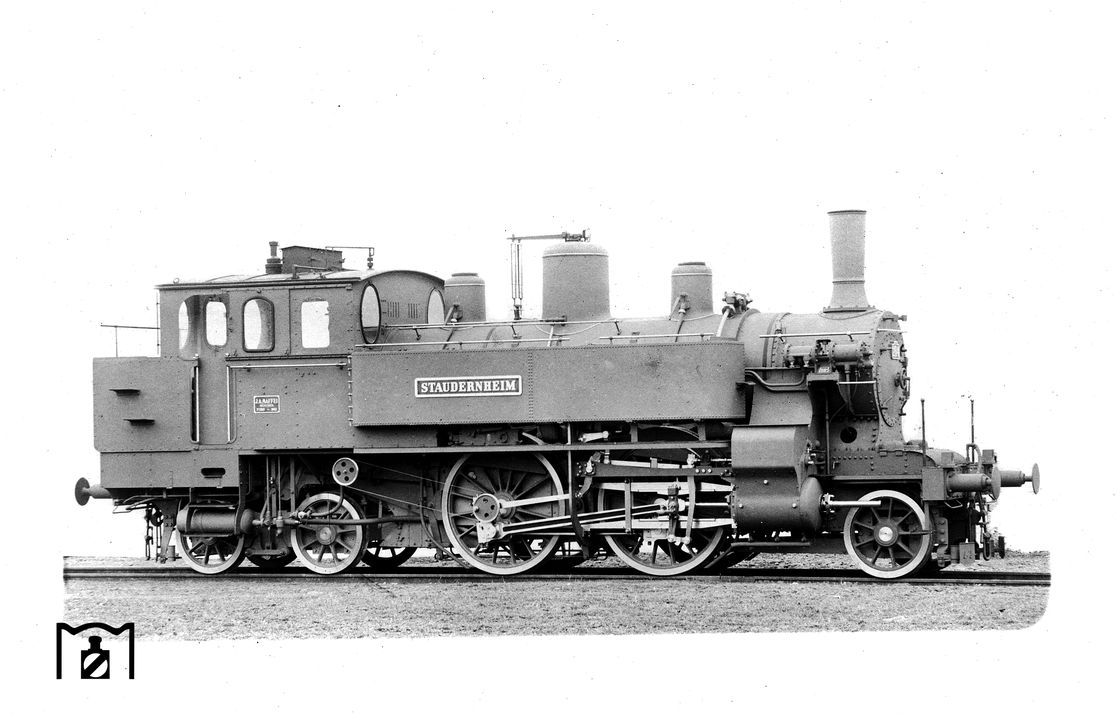
This next section come predominately from Mühl and will speak some on the historical usage and evolution of these kinds of two-axle coaches. 1861 delineates the start of what Mühl dubs second-generation coaches, which lasts until new I. and II. class stock is delivered in 1883 (Mühl, 100). Contemporaneous with their construction, the Pfalz.B. undertook a renumbering scheme, with all Maximilianbahn stock being numbered from 5001-5999 (Mühl, 99). These coaches came with multiple variations; with and without brakehouse, both open and closed options. In 1887, the railroad began installing Schleifer brakes but also began installing Carpenter brakes to have compatibility with KPEV (Prussian), K.W.St.E (Würtemmbergish), and Bad.St.B. (Badish) stock, although this was not for every coach. At the beginning of the 1880s, steam heating was introduced. Gas lamps followed in 1888. Toilets began to be introduced in III. class coaches starting in 1890 (I. and II. class coaches had them installed starting from the 1880s). Only from 1891 was most stock retrofitted with brakes. On the 1st of May 1907, the Prussians ordained that old-style two-axle stock was to be rebranded as IV. class. Resultingly, 174 coaches of this type began to be outshopped for rebuilds, while 80 new three-axle coaches were produced to take their place as III. class stock. The rebuilds were haphazard, some being in workshops and others being rushed to the rollingstock factory Rastatt. This IV. class stock was still used on relatively major lines, but behind corresponding fourth-rate locomotives. 5096 on the stretch from Neustadt-Weißenburg would have been allocated to group XVIII, pulled by a P 2.II, and been shared on the Neustadt-Marnheim route. Bearing in mind, this assignment was in 1908, when the Pfalz.B. was rostering new Atlantic type locomotives, and the P 2.IIs were rebuilt Bavarian D XIII tank locomotives (Mühl, 57, 141). Many of these IV. class coaches, like 5096, would survive the war and go into service to make up for the tribute stock sent to France after the armistice, hanging on for a few more years until demand for their replacement was met. Soon, many of the locomotives and much rolling stock was replaced with new standardized DRG types.
Conclusions
So, now we have a decent idea of what pre-1900 two-axle passenger coaches looked like and what their service life was like. While there are still details missing like liveries, we have a general overview. Many of these coaches lasted from the 1870s to the 1910s and 20s, making them an ideal pick for versatility in modelling of a specific era. Improved amenities are often the only sign of what year a photo may be from for these coaches. We know what trains they may have appeared in, their shortfalls, and their convenience in a time of need. Hopefully, this has been entertaining and informative. If even one reader is inspired to go out and do their own research on a railroad topic they care about, this blogpost will have done its job.
Many thanks once again to the good folks at DGEG for making much of this research possible and accessible.
 Pacific Northwest Chapter of European Train Enthusiasts
Leave a comment